Republic Day 2026: The Moment India Converts Ceremony into Power
A single day where constitutional legacy, EU-level diplomacy, and maritime strength converge to lock in India’s economic, strategic, and global leadership trajectory for the next decade.
Executive Summary
Republic Day 2026 is not merely an annual ceremony. In 2026, it becomes a high-leverage geopolitical and domestic policy inflection point. India’s 77th Republic Day is being executed with deliberate strategic signaling: a cultural theme embedding national symbolism, top-tier EU leadership as chief guests, expanded diplomatic visibility, and coordinated maritime and security events. Together, these elements create a rare convergence of optics and leverage. If New Delhi exploits this window correctly, it can convert ceremony into concrete outcomes on trade (India–EU FTA momentum), strategic partnerships (maritime leadership), and domestic legitimacy (national cohesion through culture and participation).
Key Facts (Short)
77th Republic Day: 26 January 2026
Official theme: 150 Years of Vande Mataram — cultural framing at the core of state messaging and citizen outreach
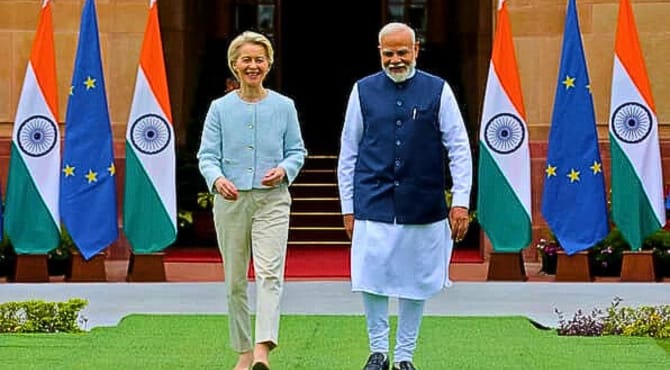
Chief guests / EU leadership presence: Senior European Union leadership, including the European Commission President, signaling elevated India–EU diplomatic and trade engagement
Expanded international and security footprint: European participation in the parade and major naval and maritime events in 2026 (International Fleet Review, MILAN-26, Indian Ocean conclave), reinforcing India’s maritime leadership narrative
National outreach: Government-led citizen participation initiatives (singing, essays, tableaux, school programs) designed to convert symbolism into civic engagement
Why 2026 Is Strategically Important — The Logic Tree
1) Diplomatic & Economic Leverage (Immediate, High EV)
What’s happening:
EU leadership is placed front and center. This presence is not symbolic; it coincides with active negotiations on the long-pending India–EU Free Trade Agreement and a broader strategic realignment.
Why it matters:
Visibility plus state-level ceremony equals bargaining power. India can translate prestige and political signaling into tangible trade concessions, regulatory cooperation, and investment commitments—driving jobs, supply-chain diversification, and technology inflows. Mishandled, the optics collapse into noise with zero payoff.
2) Strategic and Security Signaling (Medium-Term, Durable)
What’s happening:
2026 aligns large-scale naval and maritime events with expanded foreign military participation in the Republic Day parade.
Why it matters:
This demonstrates India’s capacity to act as a net security provider in the Indian Ocean. It deters adversarial pressure, improves interoperability with partners, and strengthens India’s negotiating position in defense and strategic-industrial cooperation. Security credibility directly underwrites economic diplomacy.
3) Domestic Legitimacy and Nation-Building (Immediate + Continuing)
What’s happening:
The state anchors Republic Day 2026 around Vande Mataram and mass participation programs.
Why it matters:
Republic Day becomes renewable political capital. It reinforces national identity, increases public acceptance of long-horizon policies (defense spending, reforms, infrastructure), and deepens citizen-state alignment. Executed inclusively, it strengthens cohesion; executed narrowly, it risks polarization and backlash.
4) Soft Power and Global Perception (Compounding, Long-Tail)
What’s happening:
High-visibility international participation combined with cultural, technological, and economic showcases.
Why it matters:
Soft power compounds. It lowers friction in visas, trade talks, tourism, and cultural exports, while amplifying India’s credibility in global initiatives spanning supply chains, standards-setting, and climate leadership.
Failure Modes (Explicit)
Optics without outcome: High-profile EU engagement without signed trade, tech, or security deliverables destroys credibility.
Domestic over-politicization: Cultural framing that alienates sections of society negates diplomatic gains through internal instability.
Security overstretch: Announcing maritime ambition without funding, logistics, and interoperability erodes deterrence over time.
The Single Best Move (One Decisive Recommendation)
Convert Republic Day 2026 into a signed, time-bound India–EU Trade & Strategic Partnership Roadmap (Phase-1 package).
Why this move:
It converts ceremony into permanence. A focused package combining trade liberalization, regulatory cooperation, and maritime security locks in economic returns, strategic alignment, and execution credibility—maximizing a one-time political window.
Phase-1 Package: Minimum Viable, Time-Bound
Targeted tariff liberalization on high-value manufacturing inputs and tech components, phased and conditional
Services and digital trade commitments including mutual recognition frameworks and data-flow principles
EU investment guarantees with defined FDI targets in green tech and manufacturing, backed by fast-track approvals
Maritime cooperation annex covering joint exercises, port logistics, and defense-industrial co-development
Joint monitoring cell with hard KPIs and a 12-month review cycle to enforce delivery
Operational Tasks (Prioritized)
Pre-event:
Finalize Phase-1 negotiating text; distill it into a one-page public roadmap and a detailed legal annex.
During event:
Sign the joint communiqué; announce timelines and monitoring mechanisms publicly; align tableaux and exhibits with target sectors.
Post-event:
Launch a 12-month execution sprint with monthly KPI reviews; fund one flagship pilot project to demonstrate momentum.
Measurable Success Criteria
Within 90 days:
Phase-1 Roadmap publicly signed
Monitoring cell operational
First pilot project funded
Within 12 months:
Phase-1 tariff schedules implemented
FDI commitments progressing on track
At least two joint naval exercises executed
Final Assessment — Strategic Payoff vs Cost
Upside:
A legally anchored India–EU Phase-1 package delivers outsized economic returns, strengthens supply-chain resilience, and cements India’s diplomatic and maritime leadership. The reputational signal multiplies leverage with other global partners.
Cost/Risk:
Requires disciplined negotiation, domestic political capital for calibrated liberalization, and sustained funding for maritime and defense commitments. Failure to execute wastes rare goodwill.
Closing
Republic Day 2026 is a time-limited leverage point: turn spectacle into signed, enforceable economic and strategic commitments and India secures a decade of advantage in weeks; treat it as ceremony and the moment evaporates. Act like you intend to close.