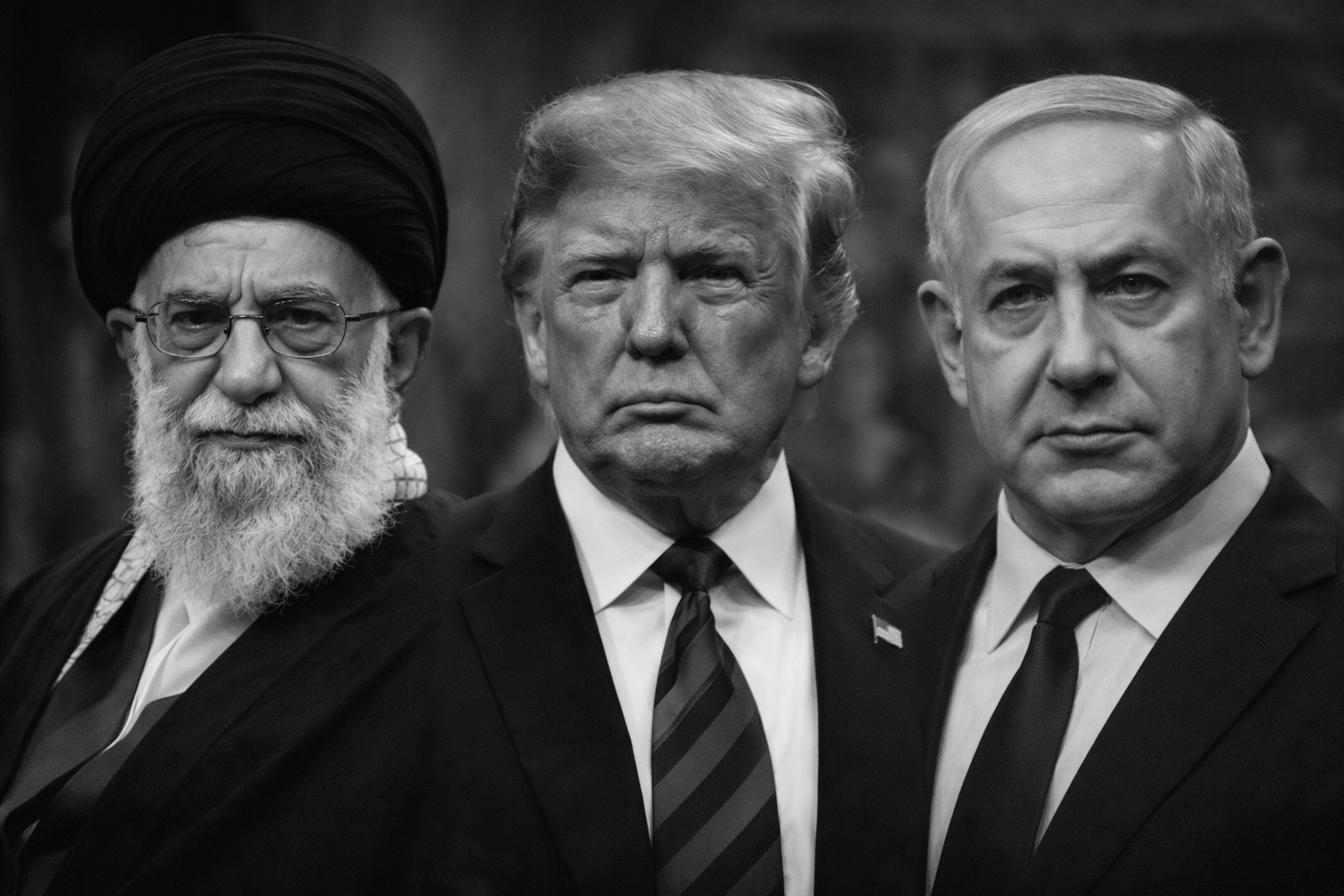
Edge of Escalation: The Strategic Anatomy of a U.S.–Israel–Iran War
How a direct confrontation could unfold from trigger event to leadership decapitation and why the global consequences would extend far beyond the battlefield.
A direct war involving the United States, Israel, and Iran would not begin with a formal declaration but with rapid escalation from an already volatile security environment shaped by nuclear tensions, proxy conflicts, and regional deterrence failures. The most plausible trigger would be a preemptive strike by Israel on Iranian nuclear infrastructure, driven by the perception of an imminent strategic threshold. The United States, already deeply integrated into Israel’s missile defense and regional security architecture, would likely be drawn into operational support, initially through air defense, intelligence coordination, and precision strikes. Iran’s retaliation would not mirror conventional invasion doctrine; instead, it would deploy ballistic missiles, long-range drones, cyber operations, and proxy forces across multiple theaters including Lebanon, Iraq, Syria, and the Gulf. The objective would be to stretch adversaries across fronts and impose economic and psychological costs rather than secure territorial gains.
As escalation intensifies, the conflict would remain primarily aerial and asymmetric. Israel would aim to degrade command-and-control networks, missile depots, and air defense systems, leveraging qualitative air superiority. The United States would reinforce regional bases and deploy naval strike groups to secure maritime corridors, particularly around the Strait of Hormuz, a critical artery for global energy flows. Even limited disruption in this chokepoint would trigger immediate spikes in oil prices, amplify inflationary pressures, and transmit economic shockwaves worldwide. Meanwhile, regional actors would face destabilization risks as militia networks aligned with Iran activate secondary fronts. The battlefield would expand digitally as cyberattacks target infrastructure, financial systems, and communication networks.
In a high-intensity scenario, a targeted strike eliminating Iran’s supreme leadership would mark an unprecedented escalation. Such a decapitation strategy would aim to disrupt centralized authority and accelerate strategic paralysis. However, regime collapse would not be guaranteed. Iran’s political system contains institutional continuity mechanisms, and the Islamic Revolutionary Guard Corps would likely assume a stabilizing—and possibly hardening—role. Leadership loss could produce internal volatility, but it might equally consolidate nationalist resistance and entrench more uncompromising factions. Historically, external strikes on leadership often intensify resolve rather than fracture state cohesion.
Globally, the conflict would sharpen geopolitical divisions. Major powers such as Russia and China would likely oppose U.S.–Israeli actions diplomatically and expand indirect support to Iran, deepening systemic polarization without necessarily entering direct combat. European states, heavily exposed to energy market volatility, would push urgently for ceasefire frameworks. The strategic balance would remain constrained by mutual escalation costs: the United States possesses overwhelming power projection capability; Israel maintains regional air dominance; Iran holds geographic depth, missile saturation capacity, and a resilient proxy network. None could achieve decisive victory without triggering broader destabilization.
Ultimately, a U.S.–Israel–Iran war would represent less a conventional clash and more a multidomain confrontation spanning airpower, cyber warfare, economic leverage, and proxy mobilization. The decisive variable would not be battlefield outcomes alone but escalation management. Without credible de-escalation channels, localized strikes could spiral into prolonged instability affecting global energy markets, alliance structures, and nuclear non-proliferation regimes. The strategic danger lies not merely in military exchange but in the cumulative erosion of regional equilibrium and the normalization of leadership-targeted warfare as a tool of statecraft.