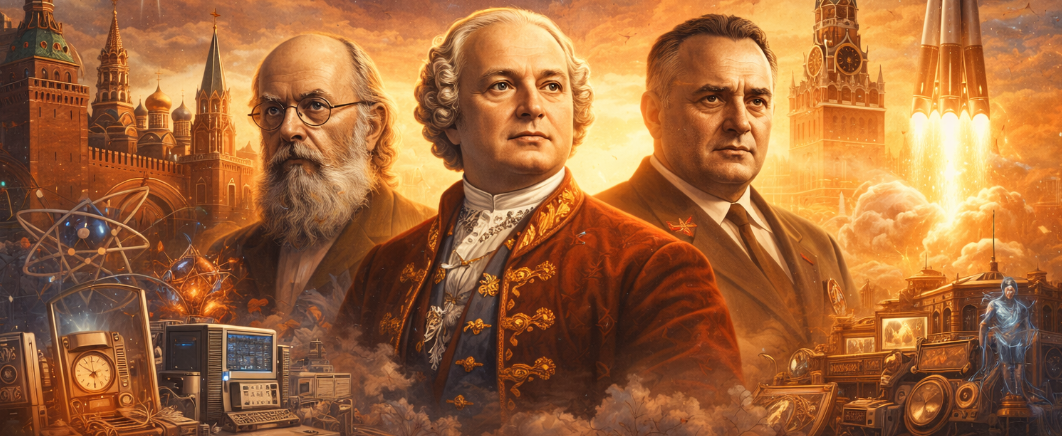
Forged Under Pressure: The Strategic Evolution of Russian Science
How state ambition, geopolitical rivalry, and centralized power transformed Russia into a scientific force while shaping the limits of its innovation model.
Russia’s scientific evolution cannot be understood as a purely intellectual story. It was never driven primarily by private innovation or market incentives. It was shaped by geography, insecurity, state ambition, and geopolitical competition. Russian science developed as an instrument of national survival and power projection rather than as a decentralized ecosystem of independent discovery.
Imperial Foundations: Science as Modernization Tool
Modern Russian science began as a defensive modernization strategy. In the 18th century, Russian rulers recognized that technological inferiority meant military vulnerability. Scientific institutions were therefore established not as cultural luxuries, but as strategic infrastructure. The early academy system imported European knowledge while attempting to cultivate domestic capability. This phase established a recurring pattern: science in Russia would remain closely aligned with state objectives rather than private enterprise.
Throughout the 19th century, Russia produced globally influential theoretical scientists, particularly in mathematics and chemistry. However, scientific advancement coexisted with political rigidity and economic underdevelopment. The Russian Empire lacked the industrial-commercial dynamism seen in Western Europe. As a result, scientific excellence often remained concentrated in elite intellectual circles rather than diffused across the broader economy.
Soviet Transformation: Centralization and Militarization
The 1917 Revolution marked a structural shift. The Soviet state treated science as a pillar of ideological and military competition. Massive centralized investment flowed into physics, engineering, aerospace, and mathematics. Education systems were redesigned to prioritize technical training, and scientific research became tightly integrated with state planning.
This model produced extraordinary results in specific domains. The Soviet Union achieved nuclear parity with the United States, pioneered space exploration, and cultivated world-leading theoretical physicists and mathematicians. The launch of Sputnik and the first human spaceflight were not merely technological achievements—they were geopolitical signals. Science became a symbol of systemic superiority.
However, this model had constraints. Innovation was vertically controlled. Research priorities were dictated by political leadership. Fields aligned with military or ideological value thrived, while others stagnated. The absence of market-driven competition limited commercialization and consumer technology development. Scientific excellence existed, but entrepreneurial ecosystems did not.
Collapse and Brain Drain: Post-1991 Disruption
The dissolution of the Soviet Union triggered systemic shock. Funding collapsed, research institutions deteriorated, and many leading scientists emigrated. The 1990s represented a severe contraction in state-backed research capacity. Russia retained intellectual capital but lacked financial and institutional stability.
During this period, global integration increased, yet domestic scientific infrastructure weakened. The transition from central planning to market capitalism did not automatically generate a Silicon Valley-style innovation ecosystem. Institutional trust, venture capital depth, and regulatory stability were insufficient to replicate Western models rapidly.
Strategic Recalibration in the 21st Century
In the 2000s, Russia began rebuilding selective scientific capacity, particularly in areas aligned with national security and strategic autonomy. Investment focused on defense technologies, nuclear energy, cybersecurity, aerospace, and artificial intelligence. The objective shifted from global scientific dominance to strategic resilience.
Russia remains strong in theoretical mathematics, physics, and certain engineering disciplines. Its education system continues to produce high-level technical talent. However, integration into global scientific collaboration has fluctuated due to geopolitical tensions and sanctions. Isolation pressures domestic innovation systems while reinforcing state control over priority sectors.
Structural Strengths
Russia’s scientific culture retains several enduring advantages. First, deep emphasis on mathematical rigor and theoretical training creates strong analytical foundations. Second, centralized coordination allows rapid mobilization of resources in targeted sectors. Third, historical expertise in aerospace, nuclear engineering, and defense technologies provides continuity of capability.
These strengths are particularly effective in state-priority domains requiring long-term strategic investment rather than short-term consumer profitability.
Structural Constraints
However, systemic weaknesses persist. Limited venture capital ecosystems constrain civilian technological scaling. Political centralization can discourage independent research autonomy. International sanctions restrict technology transfer and global collaboration. Brain drain remains a latent risk, particularly among younger scientists seeking broader opportunity.
Unlike decentralized innovation hubs driven by private enterprise, Russia’s model depends heavily on state funding cycles. When fiscal pressure increases, research diversification narrows.
Comparative Position in the Global Scientific Order
In the emerging multipolar scientific landscape, the United States leads in private-sector innovation ecosystems, China leads in scale and manufacturing-linked research deployment, and Europe emphasizes regulatory-scientific integration. Russia occupies a specialized niche: high competence in strategic technologies with limited consumer-market penetration.
This position ensures continued relevance in defense, space, and nuclear sectors but limits dominance in global technology platforms or commercial AI markets.
Long-Term Outlook
Russia’s future scientific trajectory depends on three variables: sustained funding stability, retention of top-tier talent, and managed international engagement. If geopolitical isolation deepens, scientific collaboration networks may shrink, reducing cross-border innovation exchange. If partial reintegration occurs, Russia could leverage its strong theoretical base into renewed applied growth.
Historically, Russian science thrives under pressure. Its greatest breakthroughs emerged during periods of existential competition. The question is whether the current global environment will stimulate renewed innovation or constrain it through fragmentation.
Conclusion
Russia evolved scientifically through centralized ambition, not decentralized experimentation. Its system excels in strategic domains where state priority aligns with long-term research. However, its ability to compete in broad-spectrum technological innovation depends on structural flexibility, economic openness, and global integration.
Russian science is neither declining into irrelevance nor ascending into universal dominance. It remains a specialized power—formidable in select arenas, constrained in others—shaped by the same geopolitical forces that defined its rise.