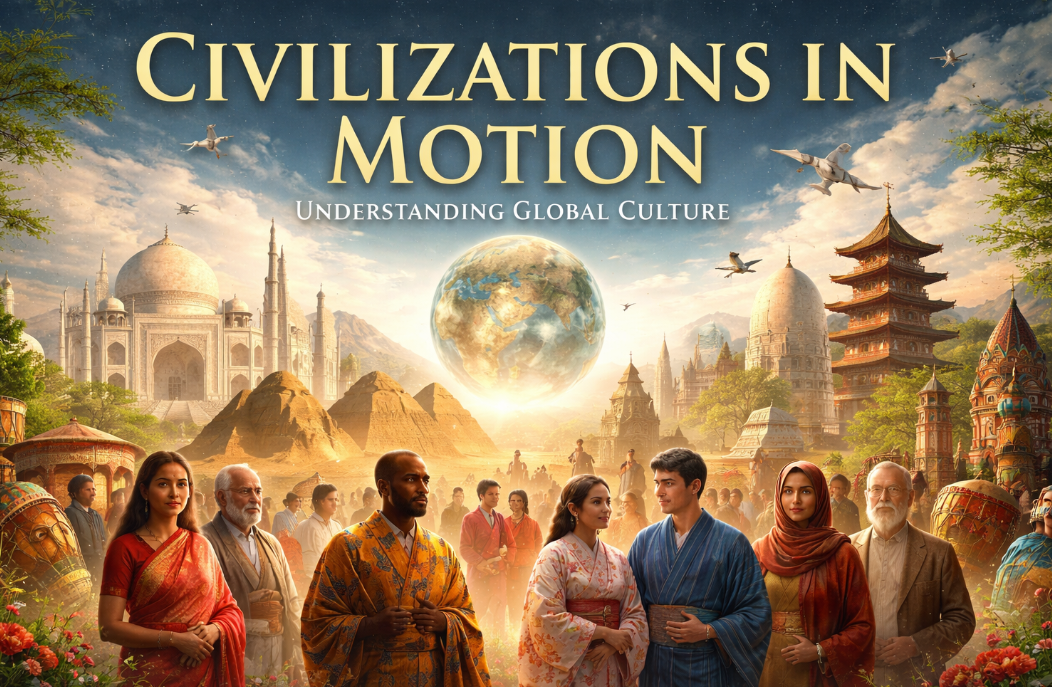
Civilizations in Motion: Understanding the Power and Patterns of Global Cultures
A strategic examination of how history, geography, belief systems, economics, and technology shape the world’s cultural identities and how those identities influence global power.
Culture is not aesthetics. It is not food, clothing, or festivals alone. Culture is a society’s operating system. It determines how people think, cooperate, build institutions, resolve conflict, and pursue progress. To understand the modern world, one must understand cultural frameworks as deeply as economic or military systems. Culture shapes national behavior long before policy documents are written.
Civilizations evolved under different geographic and historical pressures. Coastal trading societies developed outward-looking, exchange-oriented mindsets. Landlocked or historically invaded regions often developed strong internal cohesion and defensive identity narratives. Geography influenced survival strategies, and over centuries those strategies crystallized into values, rituals, and collective memory. What we now call “culture” is accumulated adaptation.
Religion and belief systems further structured social order. In some regions, religion became deeply integrated with governance and law, forming centralized moral frameworks. In others, secular institutional development gradually separated state from faith. These divergences continue to influence debates about authority, individual freedom, and collective responsibility. Cultural attitudes toward hierarchy, gender roles, and innovation frequently trace back to foundational belief structures.
Economic development has not erased cultural difference; it has amplified it. Industrialization and digital connectivity create surface-level similarities—global brands, shared entertainment, cross-border communication. Yet beneath that layer, value systems persist. Societies differ in how they define success, measure social status, treat failure, and distribute opportunity. Even corporate cultures reflect national patterns in risk tolerance, decision-making speed, and power distance.
Technology is accelerating cultural convergence while simultaneously strengthening identity preservation. Social media allows local traditions to reach global audiences, creating both appreciation and friction. Diaspora communities act as bridges between worlds, blending customs while maintaining heritage. At the same time, rapid globalization can trigger cultural defensiveness, leading to renewed emphasis on national or civilizational identity.
In a multipolar world, cultural intelligence is becoming a strategic necessity. Diplomatic success increasingly depends on understanding negotiation styles shaped by cultural norms. Business expansion requires awareness of trust-building mechanisms that vary across regions. Even conflict often emerges from misinterpretation of cultural signaling rather than purely material disputes.
Migration patterns are reshaping demographic balances in major economies. As multicultural societies expand, governance models must adapt to pluralism without losing cohesion. Integration strategies differ widely: some prioritize assimilation into a shared civic identity, while others promote multicultural coexistence. The long-term stability of nations may depend on how effectively they manage this cultural synthesis.
Youth demographics also play a decisive role. Younger populations in emerging economies are blending traditional values with digital modernity. This hybrid identity challenges conventional classifications of “Western” and “Eastern” cultural models. Cultural influence is no longer a one-directional export from developed economies; it is increasingly reciprocal.
Soft power—the ability to influence without coercion—relies heavily on cultural export. Film, music, language, education systems, and digital platforms extend a nation’s narrative globally. Countries investing strategically in cultural projection enhance their diplomatic leverage. In contrast, cultural misalignment can weaken alliances even when economic interests align.
Ultimately, global culture is not converging into uniformity. It is reorganizing into interconnected yet distinct spheres of identity. The future will likely feature intensified cultural interaction, occasional friction, and selective adaptation. Nations and institutions that develop cultural literacy—understanding both their own foundational identity and that of others—will navigate this transformation more effectively.
To analyze the world without analyzing culture is to read only half the map. Culture defines motivation, legitimacy, and collective ambition. In the coming decades, cultural strategy may prove as decisive as economic policy or military capability in shaping global order.